Déjà Vu
The hall was right there.
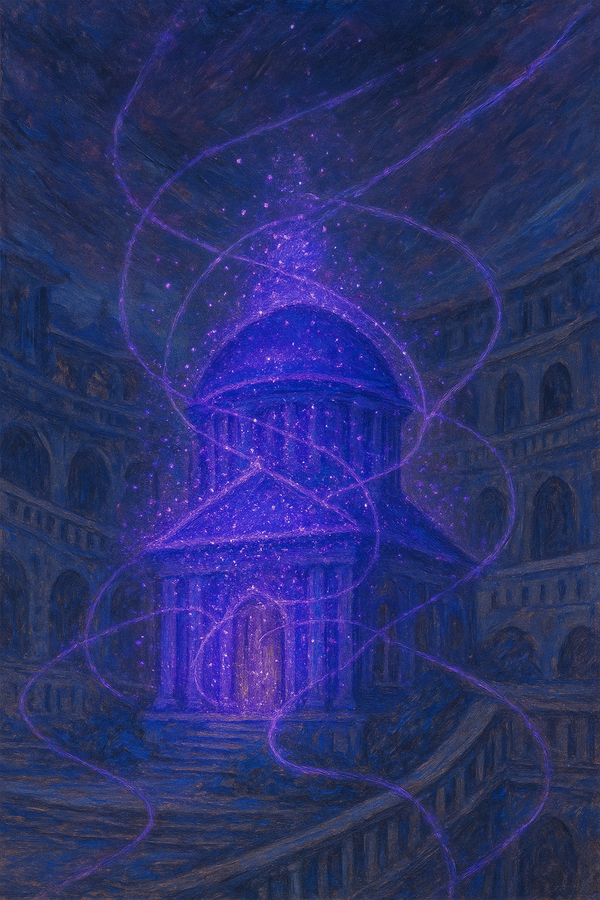
He'd expected streets. Distance. Some need to navigate. Instead the portal had set him down directly outside it—the city at full scale on either side, and the entrance immediately ahead. The stonework was cold. The indigo aura ran its edges—same outline, full scale.
The archway had carvings — symbols, densely packed. He almost recognized the shapes.
He went in.
The Mage was already there—standing near the top of the steps, watching the stage below. He didn't turn when Dæmon entered.
"You've been here before," the Mage said.
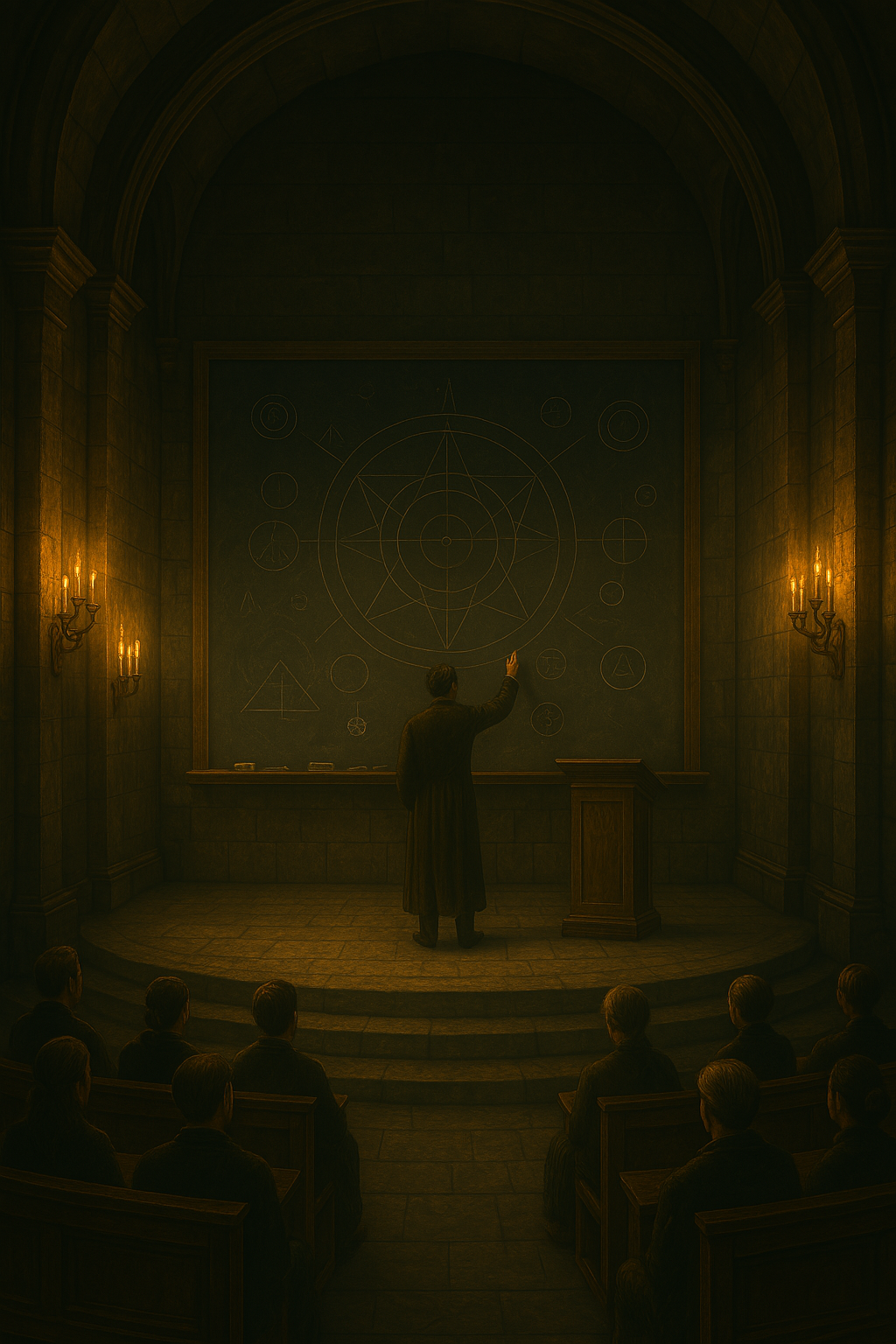
Inside—vaulted ceilings, spiral balconies, tiered rows of stone benches etched with symbols he almost recognized. An audience already seated—not restless, not silent, but awake. Some wore robes, others suits; some held notebooks, some stared without blinking. The lecturer stood at the center, robes drifting slightly as if stirred by a breeze that didn't exist.
They descended a few steps. Dæmon took a seat near the back.
"Let us begin not with ourselves, but with the bees."
Dæmon went still.
"A hive is not a collection of insects. It is a being."
There it was. He'd heard this before—not like this, not in a room, not sitting. In the café, half-absent, the voice arriving like a frequency already mid-sentence. The line he'd half-heard between bites of cold toast, not sure if his eyes were open or closed.
"You're right. I've seen this one."
He said it quietly, like he was still deciding whether it was true.
The Mage's hand moved. The lecturer stopped mid-gesture—robe held mid-wave, the breeze that stirred it pausing with everything else.
"You triggered the same entry," the Mage said. "You arrived the same way you arrived before—same state, same questions underneath. The hall returns you to where you left off."
Dæmon frowned. "I didn't leave off anywhere. I was in a café."
"You were here," the Mage said. "You just weren't present for it."
Dæmon considered it. The thought crawled through his cortex and slipped out as the question that followed.
"So if I'd come in differently—"
"You'd hear something different. The same place, a different door."
Dæmon folded his arms. "Feels fragile."
"Feelings, too, are part of the condition."
He sat. The Mage's hand moved. The robe caught the wind again.
"The hive thinks without a brain, feels without nerves. It maintains its temperature, chooses new homes, recalls distant fields. These are not the instincts of a single bee, but the will of the hive. Why is it a being? Because it acts as one. It perceives, responds, adapts, and survives—not as a swarm of individuals, but as a singular, emergent self."
His arms stayed folded.
"Planning. Complex behavior. The fruits of thought. But does the hive think — or do the fruits grow without the tree?"
His eyes narrowed.
The chalk circled a new symbol—a mandible.
"The same is true of the ants."
The same question, differently dressed.
"Colonies that wage war, enslave rivals, construct vast architectures, and respond to changing environments. We often call these behaviors instinctual. But instinct, in this context, refers to complex behavioral algorithms encoded in each ant—shaped not for individual success, but for the survival of the colony as a whole."
"In eusocial species, evolutionary pressure acts primarily on the collective. Natural selection favors colonies that function cohesively, even at the expense of individual members. The result is a system that adapts, coordinates, and endures—a form of distributed intelligence without a central brain."
Dæmon said it almost to himself. "Selection pressure. Thousands of years acting on the colony. The behavior is baked in — not thought, not chosen."
The Mage said nothing.
The chalk moved to a new symbol—a sprawl of branching veins.
"Then there is the slime mold."
The lecturer set the chalk down. His hand found his chin. He drew breath to speak—then didn't, as if the first approach hadn't been quite right. Then:
"One cell. Many nuclei. No brain. No hierarchy. No colony. No communication. And yet. It will find the shortest path through a maze. It will choose the more nutritious option between two foods. It will share knowledge across its body without nerve or network."
Dæmon had read the slime mold thing. Used it in a presentation once—distributed problem-solving, decentralized systems. He thought he knew what it was.
The lecturer kept going.
"The slime mold has no part that understands the maze. No part that chooses. And yet the whole finds the answer. The knowledge exists nowhere—and everywhere. A single cell, doing what no single cell should be able to do."
He reached for the same move.
Selection pressure on—
On what, exactly. The plasmodium wasn't a colony. The individual cells weren't a hive. The thing solving the maze wasn't the thing that had been selected for. The categories kept sliding.
The Mage's hand moved—one gesture, precise.
The lecturer stopped. Not a natural pause. Held.
Dæmon looked over. "Can you go back—the maze part."
The Mage gestured again. The lecturer resumed, mid-sentence—"...will find the shortest path through a maze..."—ran through the passage, and stopped again.
"Forward. Back. Hold. You can pull any passage if you know it."
Dæmon looked at the board. The categories still not resolved.
The Mage's hand dropped. The lecturer reached for the chalk and turned back to the board.
"Now let us turn our attention to ourselves."
The chalk drew a circle. And inside—a thousand threads.
"We speak of ourselves as individuals. But we live in cities. We build nations. We write books, wage wars, plant crops, and send telescopes into the dark. None of these acts are performed alone. The individual cannot plant wheat, harvest it, mill it, bake it, transport it, and create the market to do so. But the system can."
The room did not breathe.
"We say that word all the time—the system. We know we're inside it. We feel its pull. Its limits. Its power. It's not a business. Not an organization. Not a government. But it isn't abstract. It isn't even a concept. It's a creature. A living superorganism. Like a hive. Like a colony. Not built from cells—but from us."
Dæmon's arms were still folded. But he was leaning forward.
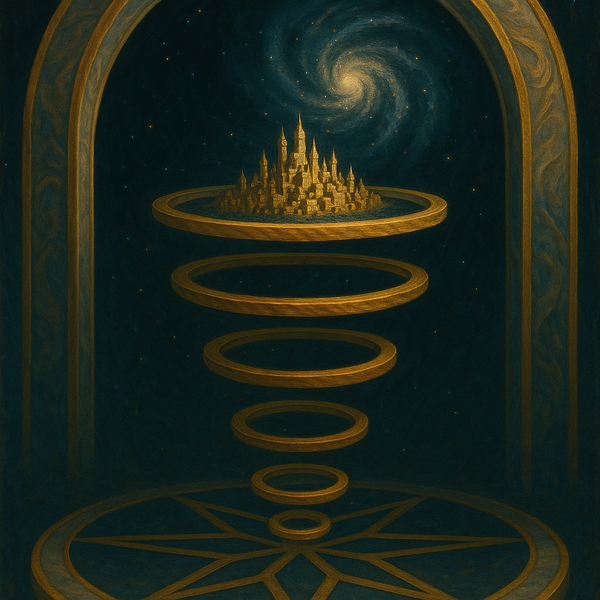
The board filled with new marks—concentric circles, each one a scale—cell, organism, colony, city, civilization. The chalk circled the outermost ring.
"We are a superorganism of our own flavor."
Dæmon's arms unfolded. He didn't decide to do it—they just moved. He noticed, and almost folded them back. Didn't.
The Mage spoke first — quietly.
"The pressure operates differently here. Cultural evolution requires minds."
The chalk was still moving.
"And if you arrive at the same conclusion I have, then you must be similarly compelled to ask:"
The chalk stilled.
"Does the collective think? Does it have its own mind?"
Silence.
His hands were open on his knees. He didn't remember unclenching them. Somewhere in the hall, chalk dust was still falling—the only thing that moved.
The Mage was watching him. He'd been watching the whole time — the lecture too, enough to run it. But mostly Dæmon.
"That's enough for one visit," the Mage said.
He had nothing. He was looking at the chalkboard—at the concentric circles, the outermost ring already beginning to fade back into the residue of everything else the hall had ever drawn. One argument among many. Settling into the surface.
He stood. The bench had been warmer than stone had any right to be.
"It knew what I was going to ask," he said. Not a question.
"It knew what you were ready to hear," the Mage replied. "Those aren't always the same thing."
The Mage made a gesture—different from the others. Not a pause.
The chalk slipped from the lecturer's hand. Stopped halfway to the floor. The air around it had solidified. The lecturer himself was mid-step, one foot raised and held—his robe stilled, the breeze that had always moved it finally gone.
Then the audience began to go.
Not by leaving. A row near the back disappeared between one moment and the next. Then a row in the middle. Then the back row returned—briefly, seats refilled, heads forward, as though nothing had interrupted—then gone again, taking a section on the left with it. A flicker. Then stillness. Then, near the center of the hall, a figure Dæmon hadn't seen all session: seated, unhurried, looking directly at him.
Gone.
The chalk reached the floor.
The board was blank. A fresh piece of chalk sat at the lectern's edge. The lecturer stood at the front of an empty hall, robes drifting, ready.
"Next time I come back—will it be the same?"
"It won't be," the Mage said. "You won't be."